
Editorial Picks
AIR FORCE ONE, A GOLD CARD AND A POLITICAL PATSY? THE NICKI MINAJ–TRUMP ALLIANCE RAISES BIG QUESTIONS

WASHINGTON — How did Nicki Minaj go from being one of rap’s most outspoken global superstars to standing beside President Donald Trump, traveling aboard Air Force One and encouraging Americans to vote Republican? And what does her increasingly visible alliance with the president mean beyond the headlines?
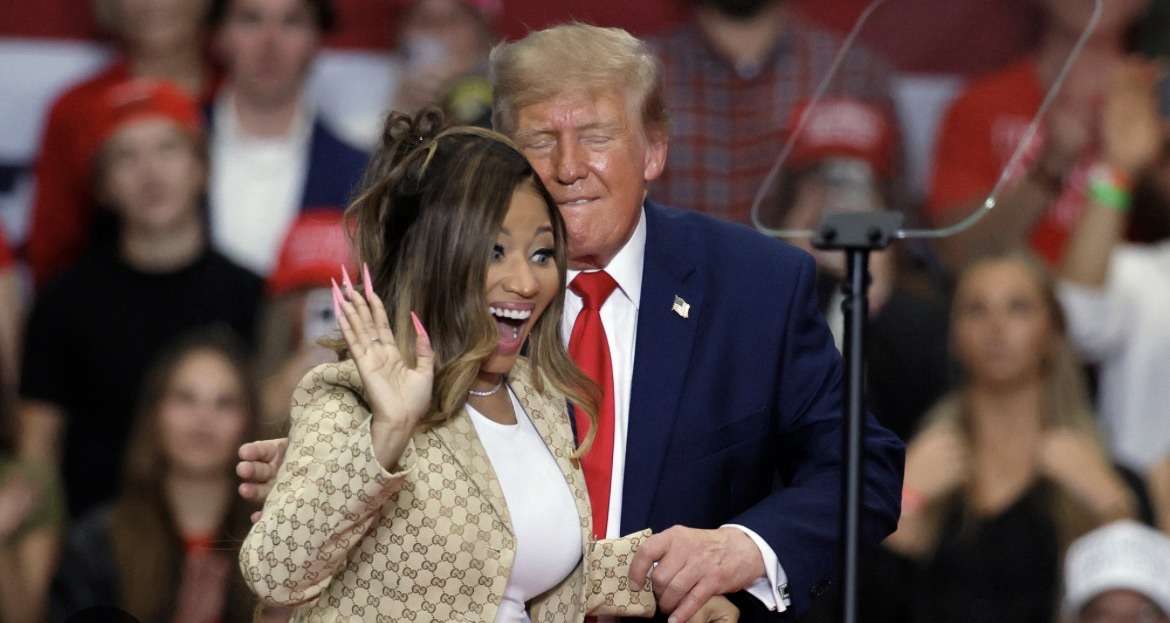
Those questions have become harder to ignore following Minaj’s appearance with Trump at a Michigan rally on October 25, where she praised his leadership and pledged to support him. Her presence aboard the presidential aircraft has further elevated her role in a political movement that has made immigration, cultural identity and national belonging central issues. <Cite refs={[“turn448129search0”,“turn448129search1”]}/>
For critics, the spectacle raises a more uncomfortable question: Is Minaj simply expressing her political beliefs, or is her celebrity being deployed to accomplish something much bigger for the Trump administration?
There is no verified evidence that Trump is blackmailing Minaj, holding compromising information over her or forcing her political allegiance. But the optics of their relationship—and the questions surrounding it—deserve serious examination.
THE CITIZENSHIP QUESTION NOBODY CAN IGNORE
Minaj was born in Trinidad and Tobago and moved to the United States as a child. In a 2024 livestream, she said she was not an American citizen. In January 2026, she subsequently indicated on social media that she was finalizing citizenship paperwork after receiving a Trump Gold Card.
A White House official reportedly characterized the card she displayed as a commemorative item rather than an official immigration document. As of the latest reporting, Minaj has not publicly confirmed that she completed naturalization. <Cite refs={[“turn448129search1”,“turn448129search10”]}/>
That distinction matters.
A celebrity traveling with the president does not need to be a U.S. citizen to board Air Force One as a guest. Nor does appearing alongside a president establish that someone has received special immigration treatment.
Still, the contrast is politically striking. Trump has built much of his political brand around immigration restrictions and a forceful vision of American identity. Minaj’s own immigration history makes her a particularly interesting figure in that conversation.
Her presence invites a legitimate question: how does the administration reconcile its hard-line immigration messaging with its embrace of a globally famous entertainer whose own citizenship journey has attracted public attention?
The answer may be as straightforward as political alliance and celebrity access. But the administration’s public explanation of her status—and any suggestion that she received special treatment—should be evaluated against documented facts rather than assumptions.
THE HUSBAND, THE BROTHER AND THE DOUBLE STANDARD
Minaj’s political alliance has also renewed scrutiny of the criminal cases involving members of her family.
Her husband, Kenneth Petty, is a registered sex offender following a 1995 conviction for attempted rape. He later pleaded guilty to failing to register as a sex offender in California. Her brother, Jelani Maraj, was convicted of predatory sexual assault against a child and received a sentence of 25 years to life. <Cite refs={[“turn448129news8”,“turn448129search12”]}/>
These are serious criminal records, and Minaj’s past public comments defending family members have attracted criticism.
But the central issue is not whether a person’s relatives have criminal convictions. Those convictions do not establish wrongdoing by Minaj, explain her political beliefs or prove that the president has leverage over her.
The more relevant question concerns consistency.
Trump’s political movement frequently presents itself as a defender of children, families and traditional values. Minaj has now aligned herself publicly with that movement, making her past statements and family associations subjects of renewed public debate.
Voters and audiences can reasonably question whether public figures apply their stated principles consistently. That scrutiny should focus on documented statements, actions and policies—not on treating a relative’s criminal record as proof of another person’s guilt.
IS CELEBRITY BECOMING A POLITICAL WEAPON?
Perhaps the most revealing aspect of this relationship is the power of celebrity itself.
Minaj has a massive international audience, an established cultural legacy and a fan base that extends far beyond traditional Republican circles. Her endorsement offers Trump something that conventional campaign messaging cannot easily manufacture: access to audiences who might never voluntarily watch a political rally or listen to a presidential speech.
When a star of her stature appears on Air Force One, stands beside the president and urges supporters to vote Republican, the event becomes more than a policy discussion. It becomes a cultural spectacle.
That is politically useful regardless of whether the celebrity’s motives are ideological, personal, financial or some combination of factors.
The question is whether fans are being encouraged to examine the administration’s policies—or whether the emotional power of celebrity is being used to make political allegiance feel like a natural extension of fandom.
Minaj has publicly expressed support for Trump, and her statements should be taken seriously as her stated position. Without evidence of coercion, it would be irresponsible to dismiss her agency or assume that she secretly opposes the movement she is promoting.
But it is equally reasonable to ask what the administration gains from putting her at the center of its public messaging.
THE SPECTACLE, THE SYMBOL AND THE HISTORY
There is another dimension to this story: the historical treatment of Black women as public spectacles whose bodies and identities become objects of political and cultural consumption.
The history of Saartjie Baartman, the Khoikhoi woman exhibited in Europe in the 19th century and later remembered through the degrading spectacle known as the “Hottentot Venus,” remains a powerful example of how race, gender and power have intersected to turn a Black woman’s body into an object for public fascination.
That history should not be treated as interchangeable with Minaj’s situation. Baartman was subjected to exploitation and racialized display in a very different historical context. Minaj is a contemporary celebrity with substantial fame, influence and agency.
Nevertheless, her sudden elevation within a political movement raises a broader cultural question: When a political establishment embraces a prominent Black woman, is it engaging seriously with her voice and the communities she represents, or primarily benefiting from the spectacle and symbolism of her presence?
The answer cannot be determined simply by looking at a photograph of Minaj aboard Air Force One. It requires examining how her image is used, which policies she endorses, what she says about those policies and whether the administration engages meaningfully with the concerns of the communities she reaches.
Her participation could represent a genuine political realignment. It could also function as strategic celebrity outreach. Those possibilities are not mutually exclusive.
THE BLACKMAIL THEORY: WHAT THE EVIDENCE ACTUALLY SHOWS
Online speculation that Trump might have something on Minaj is likely to persist because the relationship appears surprising to some observers. But surprise is not evidence of blackmail.
There is currently no verified evidence establishing that Trump possesses compromising information about Minaj, that he has threatened her or that her political support was obtained through coercion.
Several less dramatic explanations remain plausible: a genuine ideological shift, personal admiration for the president, shared cultural or policy priorities, access to influential political figures, or the advantages that come with a high-profile political alliance.
Determining which explanation best fits the facts would require evidence of Minaj’s motivations and any private arrangements between the parties. Without such evidence, a blackmail claim remains speculation.
The same standard should apply to any suggestion that her immigration paperwork, family circumstances or access to the president are connected through an undisclosed bargain.
A strong investigation would seek comment from Minaj’s representatives and the White House, examine public records concerning her citizenship status, and document any confirmed benefits or agreements rather than infer them from proximity.
THE QUESTION THAT REMAINS
Nicki Minaj has every right to express her political beliefs, and the public has every right to scrutinize the political alliances she chooses to build.
Her appearance aboard Air Force One does not establish a secret arrangement. Her citizenship status cannot be conclusively determined from an old livestream or a photograph of a gold-colored card. Her relatives’ convictions do not prove that she is compromised.
What the episode does demonstrate is the growing importance of celebrity in modern political communication.
Trump’s alliance with Minaj places a globally recognized entertainer at the intersection of immigration debates, cultural identity, partisan campaigning and public scrutiny. It also gives audiences a reason to examine whether political movements are engaging with celebrities for their ideas, their influence or both.
The most consequential question is not whether Minaj is secretly a political patsy. It is whether the public can distinguish an entertainer’s genuine political choices from the political machinery that benefits when a celebrity makes them.
Because when a global superstar boards Air Force One, the story is not just about who gets a seat on the plane. It is about who gets access to power, how that access is used and what the public should demand in return: transparency, accountability and evidence.
Limitless Magazine | Culture, Politics & Power
Editorial note: This is an opinion and news-analysis piece. The blackmail theory is unsubstantiated, and Minaj’s current citizenship status has not been publicly confirmed. The historical comparison is intended to examine cultural representation, not to equate Minaj’s circumstances with Baartman’s documented exploitation.