Cultured
Fat Joe Calls Himself the “Blackest Na Alive” — So Why Is Eminem Still Banned From the Word?*

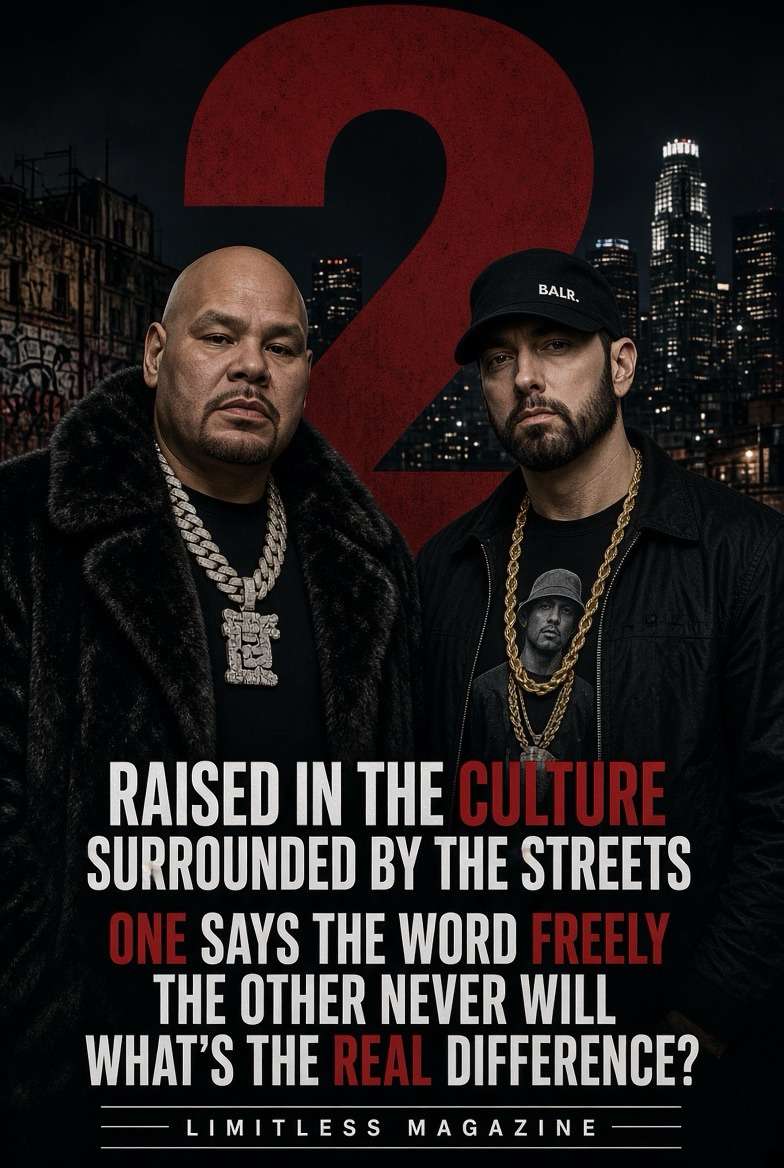
They both grew up around Black people. Both came of age inside hip-hop culture. One says the word freely. The other does not. The image circulating with Fat Joe and Eminem side-by-side asks the blunt question that keeps resurfacing: What’s the difference?
It’s not a new debate. It’s just louder again.
In early September 2026, Fat Joe appeared on The Joe Budden Podcast and doubled down. Raised in the South Bronx projects that were overwhelmingly Black, near the block where Grandmaster Flash and Melle Mel helped invent the culture, he declared himself “the Blackest na you ever seen in your life.”* He pointed to lifelong immersion, the fact that people called him the word from childhood, and his own sense that hip-hop is his culture too. Critics, including Marc Lamont Hill, pushed back hard: Fat Joe is not Black. Proximity is not a passport. There are no honorary degrees in Blackness.
Fat Joe is Puerto Rican and Cuban. He has said his father is Afro-Cuban. He has used the word for decades in music and conversation, framing it as neighborhood vernacular and a term of endearment learned in the environment that raised him. He has also acknowledged the word’s ugly history and claimed he’s tried to dial it back, while insisting no one will police what comes out of his mouth.
Eminem’s path runs parallel in some ways and diverges sharply in others. He grew up poor in majority-Black Detroit neighborhoods, one of the few white kids around, absorbed the culture at street level, and became one of the most commercially successful artists the genre has ever produced. He has generally avoided the word in his recorded catalog as an adult. Early teenage tapes from the mid-’90s contained it and other inflammatory language; those were dug up, apologized for, and contextualized as the product of adolescent anger and stupidity. A long-standing rumor that he used it in a 1998 Scribble Jam battle against Rhymefest was recently debunked by full audio.
So the meme lands. Two outsiders by conventional racial categories, both deeply inside the culture that created hip-hop, taking opposite practical approaches to the same charged word.
The deeper argument is not simply “who can say it.” It is about what the word is, who owns its reclamation, and whether cultural immersion or lived racial experience of anti-Black racism is the deciding factor.
One side treats the N-word as tightly bound to Black identity and the specific historical experience of being targeted by it. From this view, non-Black people—even those raised in Black neighborhoods, even Latinos with Afro-Latino ancestry, even artists who have spent decades in the culture—do not get to use it. The power dynamics are different. Saying it from outside that specific history carries a different weight.
The other side points to the actual lived texture of many East Coast and urban neighborhoods where Black and Latino communities overlapped for generations. In those spaces the word functioned as in-group slang long before social media turned every usage into a public referendum. Fat Joe’s defenders note that NuYoricans of his generation were not late arrivals to the culture; they were present at the creation. Context, audience, and intent matter. A white suburban kid shouting it is not the same as a Bronx Latino who has been called it and used it among peers since childhood.
Eminem’s restraint is often held up as the “correct” model for non-Black artists: respect the boundary even if you grew up inside the culture. That choice has earned him a certain credit. It has not stopped periodic attempts to weaponize old material against him. Fat Joe’s refusal to perform the same restraint is treated by some as entitlement and by others as authenticity to the specific streets that made him.
Neither position fully resolves the tension. Hip-hop was born in Black and Latino communities in the Bronx. It has always been a site of cultural exchange, appropriation debates, gatekeeping, and expansion. The N-word sits at the sharpest edge of that exchange because it is not neutral vocabulary. It carries centuries of violence and a contested modern reclamation that only some people are allowed to perform.
Roland Martin’s blunt suggestion—stop fighting over who gets a pass and stop using the word at all—cuts through some of the noise but does not match how language actually moves in the culture. The word remains common in music, freestyles, and everyday speech among many Black artists and fans. As long as that is true, the question of who else can or cannot say it will keep returning.
The image of Fat Joe and Eminem forces the comparison because their stories are close enough to make the different outcomes feel arbitrary to some and principled to others. One artist treats the word as part of the air he breathed growing up. The other treats it as a line he will not cross. Both built careers inside the same culture. Both have faced questions about belonging.
The difference is not simply skin color or neighborhood. It is a combination of racial identity, personal calculation, cultural permission, and the shifting rules of public discourse. Hip-hop has never settled that combination cleanly. The latest round of the Fat Joe conversation shows it still hasn’t.
What’s the difference? The culture itself has never fully agreed on the answer. That disagreement is part of the story.

