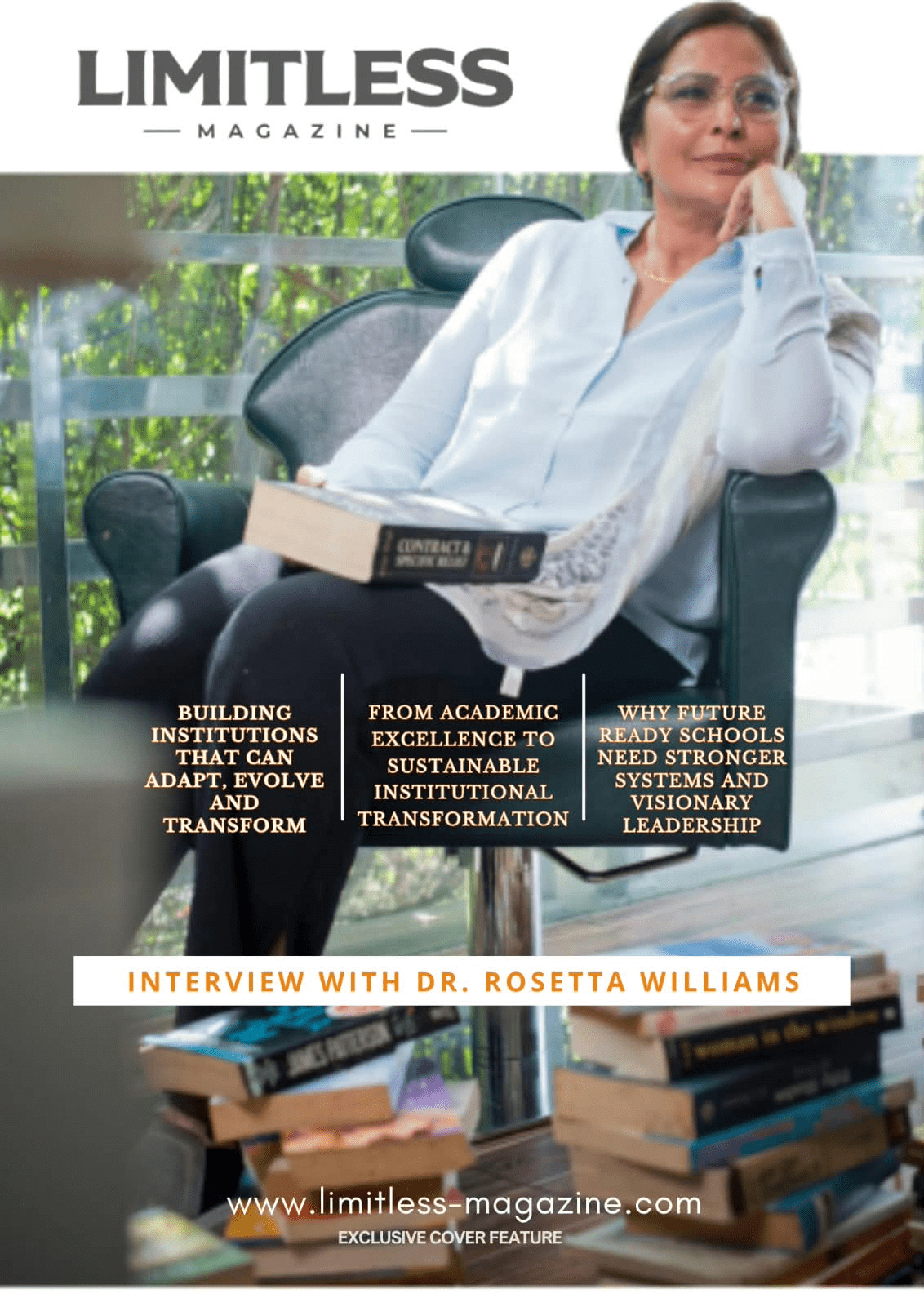

Indian school education is entering a decisive phase. The conversation is no longer limited to academic performance, infrastructure or access. Increasingly, the deeper questions concern institutional capability, leadership, governance, technology, teacher development and the ability of schools to remain relevant amid rapid social and technological change. In this conversation, Dr. Rosetta Williams examines these questions through the lens of implementation, institutional transformation and sustainable educational excellence, offering a thought leadership perspective on what schools must build today to remain prepared for tomorrow.
India has expanded access to schooling considerably, but quality remains uneven. What do you believe is the biggest gap between the way schools are currently managed and what future ready education actually requires?
Dr. Rosetta Williams: India has made significant progress in expanding access to schooling. However, I believe the biggest gap today is not a lack of ideas, it is the gap between vision and implementation. We speak extensively about future-ready education, AI, competency-based learning, innovation and 21st-century skills. Schools are increasingly aware of what the future demands. But awareness does not automatically translate into transformation. The real question is: how do we convert futuristic thinking into everyday institutional practice? A school may have an ambitious vision, but unless that vision reaches the classroom, influences teaching practices, strengthens leadership, changes decision-making and ultimately improves student outcomes, it remains an aspiration rather than transformation. This is where school management needs to evolve. Future-ready institutions cannot operate through isolated initiatives or short-term interventions. They need an integrated transformation framework where academics, leadership, teacher capability, technology, governance, student development, data and operational systems move towards a common institutional vision. I strongly believe that implementation is the bridge between imagination and impact. It requires clear roadmaps, measurable outcomes, defined accountability, continuous review and, most importantly, the ability to adapt as the world changes. At the same time, schools cannot prepare children for the future while managing themselves entirely through the thinking of the past. Futuristic thinking must become part of institutional culture—not merely predicting what education may look like five or ten years from now, but building schools that are agile enough to respond to changes we cannot yet predict. For me, therefore, transformation is not about introducing more programmes. It is about creating the institutional capability to envision the future, implement with discipline, measure impact and continuously reinvent.
Schools often focus heavily on academic outcomes while operational, governance and leadership issues receive less attention. How can school leaders create a more balanced approach to educational quality?
Dr. Rosetta Williams: Academic outcomes are important, but they are ultimately the visible result of a much larger institutional ecosystem. If leadership is weak, governance is unclear, teachers are unsupported, operations are inefficient, or implementation is inconsistent, academic excellence becomes difficult to sustain. School leaders therefore need to move from an academics-centric approach to a 360° institutional approach. Educational quality must be viewed through interconnected dimensions—academics, leadership, governance, teacher capability, operations, technology, student wellbeing, parent engagement and organisational culture. The critical element, however, is implementation. Schools often have excellent policies, strategic plans and academic frameworks, but the real test is whether these translate into everyday practice. Leaders need clear accountability structures, measurable KPIs, regular reviews and data-driven decision-making so that gaps are identified early and corrective action happens quickly. Leadership itself must also become more futuristic. A school leader today cannot only manage the current academic year; they must continuously ask: What will our students need five or ten years from now, and what capabilities must our institution build today to prepare them for that future? This requires balancing immediate academic priorities with long-term institutional transformation. Technology, AI, changing workforce expectations and evolving student needs will continue to reshape education. Schools therefore need systems that are agile enough to evolve rather than structures that simply maintain the status quo. I believe sustainable educational quality emerges when academic excellence is supported by operational excellence, strong governance and visionary leadership. Ultimately, a future-ready school is not one where only students are expected to learn and evolve. The institution itself must become a continuously learning, adapting and transforming organisation.
You have worked extensively with educators and school leaders. What are the most common leadership gaps you observe today, and what kind of leadership development can genuinely improve decision making at the school level?
Dr. Rosetta Williams: One of the most common gaps I observe is that many capable school leaders have been prepared to manage institutions, but not necessarily to transform them. They are often deeply involved in daily administration, academic schedules, compliance and immediate problem-solving, leaving limited space for strategic thinking, innovation and long-term institutional development. Another significant gap is the distance between decision-making and implementation. A good decision is only as effective as its execution. Leaders may identify the right priorities, but without clear ownership, timelines, measurable outcomes and consistent follow-through, even strong strategies lose their impact. I also see a need to strengthen data-informed decision-making, people leadership and the ability to anticipate change. Future-ready leadership requires principals and school leaders to look beyond the current academic cycle and understand how technology, AI, evolving pedagogy, changing student needs and new expectations from parents and society will influence their institutions. Leadership development, therefore, cannot be limited to occasional workshops. It must be continuous, contextual and implementation-oriented. Leaders need opportunities to work on real institutional challenges, analyse data, make decisions, implement solutions, review their impact and refine their approach. Coaching, mentoring, leadership diagnostics and structured review mechanisms can be particularly powerful when connected to actual school outcomes. Most importantly, we need to develop leaders who are comfortable not only managing certainty, but leading through change and uncertainty. For me, the real measure of leadership development is not how much a leader knows after a programme, but how differently and effectively the institution begins to function because of that leadership.
Regulatory compliance is becoming increasingly complex for educational institutions. How can schools move from viewing compliance as paperwork to building governance practices that actually improve accountability and management?
Dr. Rosetta Williams: The first shift schools need to make is in mindset: compliance should not be treated as a periodic exercise in documentation, but as an integral part of institutional governance. When compliance is approached only as paperwork, schools often become reactive—documents are prepared before inspections, responsibilities become fragmented, and the focus shifts towards demonstrating compliance rather than strengthening the institution. A future-ready school needs to move from reactive compliance to proactive governance. Every regulatory requirement should ultimately connect to a larger purpose—student safety, academic quality, financial transparency, staff accountability, operational discipline or institutional credibility. When leaders understand this connection, compliance becomes a management tool rather than an administrative burden. The key is implementation. Schools need clearly defined responsibilities, documented processes, compliance calendars, internal audits, periodic reviews and measurable accountability at every level. Technology can further strengthen this by creating real-time dashboards, automated reminders and digital records that allow leadership to identify gaps before they become risks. More importantly, governance should generate intelligence for decision-making. If compliance data is systematically reviewed, it can reveal operational weaknesses, recurring risks, capacity gaps and areas requiring leadership intervention. As education becomes more complex, schools will need governance systems that are increasingly transparent, technology-enabled, predictive and accountable. The goal should therefore not be to ask, “Are we ready for an inspection?” but rather, “Are our systems strong enough to remain accountable every day?” That is when compliance stops being paperwork and starts becoming a foundation for sustainable institutional transformation.
Many schools remain dependent on individual principals, administrators or long serving employees for critical processes. What should schools do to build stronger documentation, SOPs and systems that can survive leadership and staff transitions?
Dr. Rosetta Williams: One of the greatest risks for any school is when institutional knowledge resides with individuals rather than within the institution. Experienced principals, administrators and long-serving employees are invaluable, but when critical processes depend entirely on what they know, staff transitions can disrupt continuity and sometimes force the institution to start again. The solution is not simply creating more documents. Schools need to convert individual knowledge into institutional knowledge and executable systems. This begins by identifying critical processes across academics, administration, admissions, HR, finance, compliance, safety, communication and school operations. These processes should then be clearly documented through practical SOPs defining what needs to happen, who is responsible, when it must happen, how it is monitored and what happens when something goes wrong. However, an SOP sitting in a file is no better than an undocumented process. Implementation is crucial. Teams must be trained on these systems, responsibilities should have clear ownership, and processes should be periodically reviewed, audited and improved based on experience and changing requirements. Technology can further strengthen institutional continuity by creating centralised repositories, dashboards, automated workflows and structured handover mechanisms. This reduces dependency on memory and makes information accessible to the right people at the right time. I also believe schools must move from succession planning for positions to succession readiness of systems. Leadership will change, employees will move and new technologies will emerge. A strong institution should be able to absorb these transitions without compromising quality or losing organisational knowledge. Ultimately, people build institutions, but systems enable institutions to outlast people. A future-ready school is one where leadership transitions may change who is leading the organisation, but they do not disrupt how effectively the institution functions, learns and continues to transform.
New school projects often place considerable emphasis on infrastructure and branding. From your experience, what are the less visible areas that promoters should address before launching a new school?
Dr. Rosetta Williams: Infrastructure and branding create the first impression of a new school, but they do not determine whether that school will become a strong institution. In my experience, some of the most important work happens before the first student enters the campus—and much of it is invisible to parents. Promoters need to think beyond building a school to building an institution. That begins with clarity of educational vision: What kind of learner do we want to develop? What will differentiate the learning experience? And how will that vision translate into classroom practice, leadership behaviour and everyday decision-making? The next critical area is the institutional architecture—governance structures, leadership roles, academic frameworks, teacher recruitment and development, SOPs, compliance systems, financial planning, safeguarding, technology architecture, parent engagement and measurable quality benchmarks. These systems need to be designed together rather than added gradually after operations begin. Implementation planning is equally important. Before launch, promoters should ideally simulate the entire school journey—from a parent’s first enquiry and a teacher’s onboarding to classroom delivery, assessment, student safety, grievance management and leadership review. This often reveals gaps that infrastructure planning alone cannot identify. There must also be futuristic thinking from day one. A school being launched today is being built for children who will graduate into a very different world. Decisions around pedagogy, AI and technology, skills, spaces and teacher capability therefore need to consider not only what works today, but what the institution must be capable of becoming tomorrow. I often say that a beautiful campus can attract attention, but strong systems create trust and educational quality creates legacy. The strongest new schools are therefore not those that simply open on time; they are those that begin with the institutional capability to continuously evolve, implement and transform.
When a school experiences declining enrolment, financial pressure or operational inefficiencies, the immediate response is often to address the visible symptoms. How should leaders approach a genuine school turnaround?
Dr. Rosetta Williams: A genuine school turnaround begins with one fundamental principle: do not confuse the symptom with the problem. Declining enrolment, financial pressure or operational inefficiency is often the visible outcome of deeper institutional issues. Falling admissions, for example, may be connected to academic perception, parent experience, leadership gaps, teacher quality, competition, communication or an unclear value proposition. Addressing enrolment purely through marketing may therefore provide temporary visibility without solving the underlying problem. The first step must be a 360° institutional diagnosis. Leaders need to examine academics, enrolment trends, finances, people, governance, operations, parent and student experience, technology, market positioning and leadership capability together. The objective is to understand not only what is going wrong, but why it is happening. Once the root causes are clear, the school needs a prioritised turnaround roadmap. Not everything can or should be changed simultaneously. Leaders must distinguish between immediate interventions required to stabilise the institution, medium-term measures that rebuild performance and confidence, and long-term transformation that makes the school future-ready. Implementation is where turnaround succeeds or fails. Every intervention needs clear ownership, timelines, measurable outcomes and frequent review. Data should become a management tool, allowing leaders to see quickly what is improving, what is not and where course correction is required. At the same time, turnaround cannot simply mean cost-cutting. Financial discipline is important, but indiscriminate reduction can weaken the very academic and organisational capabilities required for recovery. The objective should be to create greater educational and operational value from every resource available. Most importantly, leaders must recognise that turnaround is not about restoring yesterday’s school. It is an opportunity to reimagine what the institution needs to become tomorrow. For me, successful turnaround follows a clear progression: diagnose deeply, stabilise intelligently, implement rigorously, measure continuously and transform sustainably. That is how a struggling school moves beyond short-term recovery and builds the capability to remain relevant, resilient and competitive.

Artificial intelligence is rapidly entering classrooms and administrative functions. What should school leaders consider before adopting AI, ERP platforms or other digital systems, and how can technology remain aligned with educational purpose?
Dr. Rosetta Williams: When it comes to AI, ERP platforms or digital systems, I believe the biggest challenge for schools is no longer access to technology it is successful implementation. Schools often invest in technology with considerable enthusiasm, but implementation cannot end with purchasing a platform, installing software or conducting one round of training. The real question is: has the technology actually changed the way the institution functions? Before adoption, leaders should clearly identify the problem being addressed and define the expected outcome. If an ERP is being introduced, for example, schools should determine which processes it will simplify, what data it will capture, who will use that data and how it will improve decision-making. Similarly, AI implementation should begin with specific educational and administrative use cases rather than broad adoption without defined purpose. The next stage is implementation readiness. Schools need to map existing processes, assign ownership, prepare users, migrate and validate data, integrate workflows, establish protocols and create clear timelines. Most importantly, teachers and staff must understand how the technology fits into their everyday work. Without user adoption, even the best system remains underutilised. Implementation must then be measured. Leaders should regularly review usage, efficiency, learning impact, data accuracy and user feedback. If a system is not producing the intended outcome, the institution should be willing to modify the process rather than simply continue because an investment has already been made. With AI, implementation also requires strong guardrails around privacy, security, accuracy, academic integrity and human oversight. These cannot be added as an afterthought. I see technology implementation as a continuous cycle: identify the need, prepare the institution, implement, measure, refine and scale. Ultimately, successful digital transformation is not demonstrated by how many platforms a school has purchased, but by how consistently those platforms are used, how well they integrate into institutional processes, and what measurable improvement they create for students, teachers and school leadership.
Teacher development is frequently treated as a periodic training exercise. What would a more meaningful approach to continuous professional development look like, particularly for teachers, principals and academic leaders?
Dr. Rosetta Williams: The biggest limitation of traditional professional development is that it often ends when the training session ends. Exposure to a new idea is not the same as implementation, and implementation is not the same as impact. A more meaningful approach to professional development must therefore move from periodic training to a continuous cycle of learning, application, observation, feedback and improvement. For teachers, every development intervention should translate into classroom practice. If we train teachers in differentiated instruction, assessment strategies, technology or AI, the next question should be: What changed in the classroom? This requires classroom observations, mentoring, peer learning, demonstration lessons, feedback and evidence of student impact. The same principle applies to principals and academic leaders. Leadership development should not remain theoretical. Leaders should work on real institutional challenges— academic performance, teacher capability, parent engagement, operational efficiency or technology implementation—and be supported in converting learning into measurable action. I also believe professional development should be diagnostic rather than generic. Different schools, leaders and teachers have different capability gaps. Training should begin by identifying those gaps and then creating development pathways aligned with individual roles as well as institutional priorities. Most importantly, schools must create an environment where professional development becomes part of everyday work rather than an occasional event on the calendar. Reflection, coaching, collaboration, experimentation and continuous feedback should become embedded in the culture. Ultimately, I would measure the success of professional development not by how many training hours were completed, but by what changed afterwards in teaching practice, leadership decisions, institutional processes and, eventually, student outcomes. That is when professional development moves from training people to building institutional capability.
Education increasingly involves multiple disciplines, including academics, governance, finance, technology, compliance, operations and leadership. Why is a multidisciplinary approach becoming important for schools seeking sustainable growth?
Dr. Rosetta Williams: Schools today are far more complex institutions than they were even a decade ago. Academic excellence remains at the heart of education, but it cannot be sustained in isolation. What happens in the classroom is increasingly influenced by what happens across leadership, governance, finance, technology, compliance and operations. This is why a multidisciplinary approach has become essential. A school may have a strong academic vision, but without sound financial planning it may struggle to sustain it. It may invest in technology, but without teacher capability and implementation systems the investment may remain underutilised. Similarly, ambitious growth without strong governance, compliance and operational processes can create vulnerabilities as the institution expands. The challenge is that these areas are often managed as separate functions. Sustainable growth requires leaders to understand their interdependence and bring them together around a common institutional purpose. For me, this is where a 360° approach to institutional transformation becomes important. Before introducing solutions, leaders need to understand how a decision in one area will affect the rest of the institution. Strategy must then translate into coordinated implementation—with clear ownership, timelines, accountability and measurable outcomes across functions. This also requires futuristic thinking. Schools are preparing students for a world shaped by AI, new professions, changing skills and rapidly evolving social expectations. Institutions themselves must therefore become more agile, collaborative and capable of adapting across disciplines. Ultimately, sustainable growth does not come from strengthening one department at a time. It comes from strengthening the connections between them. When academics, governance, finance, technology, compliance, operations and leadership begin working as one integrated ecosystem, a school moves beyond managing individual functions and starts building the institutional capability required to grow, adapt and transform sustainably.
If you were advising a school leader who knows that the organisation needs to evolve but is unsure where to begin, what would be the first three questions you would ask them, and what kind of professional support should they consider thereafter?
Dr. Rosetta Williams: When a school leader knows that the institution needs to evolve, my first advice is: do not begin with a solution; begin with the right questions. The first three questions I would ask are: First: Where are we today—really? Not where we believe the school is, but what the evidence tells us. What are the realities across academics, leadership, people, governance, finance, operations, technology, compliance, enrolment and stakeholder experience? Second: Where do we want this institution to be in the next three to five years? Transformation needs a destination. Leaders must define what they want the school to become, what kind of learning experience they want to create, and what capabilities the institution will need to remain relevant in a rapidly changing educational environment. Third: What is preventing us from getting there? This is often the most important question. The barrier may not be a lack of ideas or resources. It could be leadership capability, execution gaps, outdated processes, fragmented systems, resistance to change or simply the absence of clear accountability. Once these questions are answered, professional support should begin with a 360° institutional diagnosis, followed by a prioritised transformation roadmap. But I strongly believe support should not stop at recommendations. Schools rarely need another report telling them what could be improved; they need partners who can help translate strategy into implementation. That support may involve leadership mentoring, process redesign, academic strengthening, SOP development, technology integration, governance, capability building and structured performance reviews, depending on the institution’s actual needs. Most importantly, external support should ultimately reduce dependency on external support. The objective should be to build internal capability so that the school can continue improving, innovating and transforming independently. For me, meaningful transformation follows a simple progression: understand where you are, define where you want to go, identify what is holding you back and then implement with discipline.
India’s next chapter in school education will not be defined simply by how many institutions adopt new technologies, introduce new programmes or expand their infrastructure. It will be defined by how deeply schools strengthen the systems, leadership, governance and professional capability that allow meaningful change to endure. The central challenge is therefore not merely preparing students for a changing India, but preparing institutions themselves to keep learning, adapting and improving.
Dr. Rosetta Williams’ perspective ultimately points towards a more demanding definition of educational excellence. A future ready school must be academically credible, operationally disciplined, ethically governed, technologically purposeful and capable of sustaining improvement beyond individual leaders or short term initiatives. The institutions that understand this shift will not merely respond to the future. They will possess the capability to shape it.


