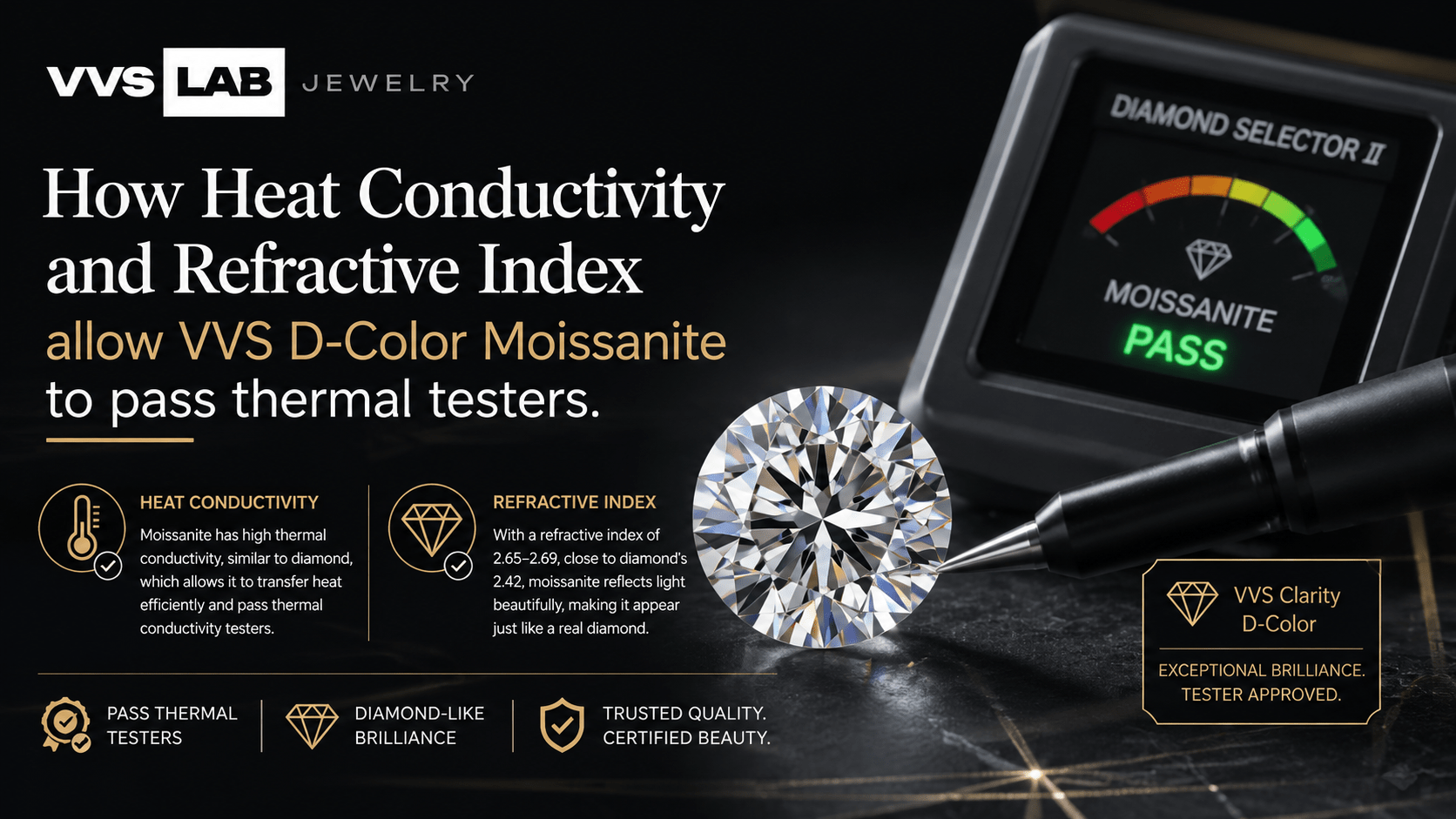

Can a VVS D-Color moissanite watch set off a diamond thermal tester? Yes — because high-grade moissanite moves heat enough like diamond that plenty of basic handheld testers will call it “diamond” without asking better questions.
That doesn’t make moissanite some fake-diamond punchline. It means the tester is checking one tiny clue, and moissanite gives it almost exactly what it wants to hear.
Why Basic Thermal Testers Get Moissanite Wrong
Most pocket diamond testers are nowhere close to a gem lab. Most of them are heat-flow gauges with a needle tip and a very persuasive beep.
The probe tip warms the stone and measures how quickly heat moves through it. Diamond conducts heat extremely well, which is why old-school testers were built around thermal conductivity in the first place.
The catch is that moissanite runs close enough behind diamond to fool plenty of older or cheaper testers.
Cubic zirconia, glass, and cheap crystal usually fall apart here because heat moves through them in a completely different way. Moissanite, especially clean VVS-grade stones, can move heat fast enough to land in the diamond zone on many older or budget testers.
That’s how someone taps a probe on a moissanite bezel, hears the chirp, and immediately decides the watch must be diamond-set. The tester isn’t exactly lying. It’s answering a very small question that people love to treat like a full appraisal.
The Refractive Index Is Why It Looks So Convincing
Heat conductivity is why the tester chirps; refractive index is why the watch starts throwing color the second it hits LEDs.
Diamond has a refractive index of about 2.42. Moissanite is higher, around 2.65 to 2.69, which means it bends light even more aggressively. That extra dispersion is what gives moissanite those hard rainbow flashes under LEDs, phone flash, and the brutal little spotlights in jewelry cases.
On a watch, that gap shows up fast because you’re not judging one stone — you’re staring at a moving wall of them.
One loose stone can be rolled under a loupe, tilted slowly, and judged without all the noise. A flooded case, bezel, dial, and bracelet are a completely different problem. Hundreds of tiny stones are prong-set close together, often over rhodium-plated 925 sterling silver or stainless steel, so the eye reads the entire surface as one moving field of light.
That’s why VVS Lab Jewelry uses VVS clarity and D-color moissanite in watch builds: pack stones that tightly and one milky or warmer piece will jump out immediately.
Quick Spec Check: Diamond vs. Moissanite vs. CZ
| Property | Diamond | Moissanite | Cubic Zirconia |
| Refractive index | ~2.42 | ~2.65–2.69 | ~2.15–2.18 |
| Mohs hardness | 10 | ~9.25 | ~8–8.5 |
| Thermal conductivity | Very high | High | Low |
| Common thermal tester result | Diamond | Often diamond | Usually not diamond |
| Visual fire | Strong | Very strong | Softer, glassier |
That’s the odd little lane moissanite owns. It’s not diamond, but compared with the usual lookalikes, it gets much closer on the two things buyers notice first: the tester response and the flash.
The Watch Setting Makes Testing Even Trickier
Testing one loose stone is the simple version. Testing a fully iced watch is where the results start getting messy.
Small stones create shallow contact points for the probe. Metal around the stone can act as a heat sink. Curved bezels and bracelet links make it harder to keep the tester tip perfectly still. If the watch uses micro-pavé or tight prong-setting, the probe may partly touch metal, partly touch stone, or slide between stones.
So no, one quick beep on a crowded bezel doesn’t settle anything.
A better check uses a few tools, not just one beep:
- A thermal tester for first-pass screening
- An electrical conductivity tester, since moissanite often conducts electricity differently from diamond
- 10x magnification to inspect facet doubling, prongs, and stone uniformity
- A UV light test, when useful, though fluorescence is not definitive
- Paperwork or seller disclosure that clearly says moissanite, not diamond
This is the point where a real jewelry seller is worth more than another close-up video with a beep. Random marketplace sellers love blurry “diamond pass” clips; better jewelers tell you what the stones are and let the setting work show clearly. In the mid-to-premium moissanite watch space, collections oficed out timepieces should be judged on stone grade, setting work, movement, plating, and honest disclosure — not just a shaky tester video.
Passing a Tester Is Not the Same as Being Diamond
Honestly, leading with “passes diamond tester” feels like lazy marketing.
It sounds flashy for five seconds, then skips over the actual reason VVS D-Color moissanite works. It is hard enough for daily wear, bright enough to flood a watch case with fire, and significantly more accessible than natural diamond pavé.
The real flex is a watch with tight setting work, clean stones, and a case that doesn’t feel flimsy — not a pitch built around tricking a pocket tester.
Conclusion: Why the Tester Beeps and the Watch Still Hits
How heat conductivity and refractive index allow VVS D-Color moissanite to pass thermal testers comes down to two facts: moissanite transfers heat quickly, and it bends light with serious intensity. That combination is exactly why it looks so loud on the wrist and gives basic testers a headache.
If you’re shopping, don’t let one beep from a tester make the whole decision for you. Look for VVS clarity, D-color consistency, secure prong-setting, clear material disclosure, and a seller like VVS Lab Jewelry that presents moissanite as moissanite — brilliant, technical, and worthy without the diamond costume.

