
There has never been more content, more coaching, more mentorship available to founders. And yet the gap between what gets said on stage and what actually helps remains stubbornly wide.
The advice economy has never been more abundant. Podcasts, newsletters, accelerator programmes, mentorship platforms, speaker circuits, MBA electives, online cohorts, at no point in history has it been easier to access the accumulated wisdom of people who have built companies. And yet, speak to founders in the thick of it and a strange dissonance emerges. They are consuming more guidance than any previous generation. They are not necessarily better equipped.
Part of the problem is supply-side. The economics of the advice industry reward polish over precision. The keynote that travels well is the one with a clean three-step framework and a redemptive arc, not the one that accurately describes how messy and contingent most business-building actually is. Speakers get booked again for being compelling; they do not get booked again for being right. Over time, this selection pressure produces a body of publicly available wisdom that is optimised for inspiration and systematically underweighted on difficulty.
Where the Useful Knowledge Lives
The more useful knowledge tends to live in smaller rooms. It surfaces in the kind of frank conversation that happens between a mentor and a founder who have built enough trust to be direct with each other, or in a workshop setting where the social stakes of admitting uncertainty are low enough that people actually do. It rarely makes it onto a main stage, because main stages have different incentives.
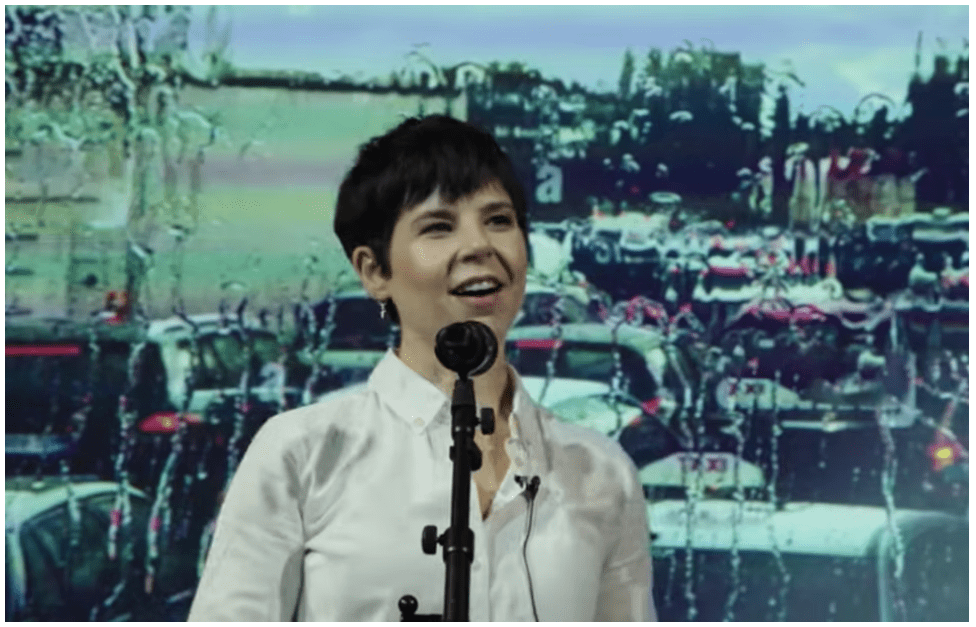
Stephanie Melodia has spent a significant part of her career trying to close that gap. The entrepreneur and founder and former CEO of Bloom, a London marketing agency she built to serve early and growth-stage startups, has been a speaker at events including Web Summit in Lisbon, Collision in Toronto, Women in Tech in Stockholm, and TechBBQ, and has developed a body of work around the less-discussed dimensions of entrepreneurship. Her ‘Hacking Luck’ framework, which examines the external factors that shape business outcomes and how founders can position themselves more intelligently relative to them, has been developed and delivered as a programme for private clients, a deliberate choice that reflects a belief in depth over reach when the ideas are still being refined. Melodia hosts the Strategy & Tragedy podcast, advises MBA students in entrepreneurship through Oneday, and has been featured in Forbes.
The Bloom 100, an internal review Melodia conducted across a hundred of her agency’s client companies, is instructive about where the useful patterns are. The startups that navigated difficulty best were not those with the most sophisticated strategies on paper. They were the ones whose founders had developed a particular kind of cognitive flexibility: an ability to hold uncertainty without becoming paralysed by it, to make decisions with incomplete information, and to recalibrate without treating every change of direction as a failure. These are not skills that feature prominently in most accelerator curricula.
Rethinking What Mentorship Is For
The mentorship conversation in the startup ecosystem has matured considerably in recent years, but it still tends to default to a transmission model: an experienced person passing knowledge to a less experienced person. What is rarer, and arguably more valuable, is the kind of mentorship that helps founders develop better thinking rather than simply providing better answers. The distinction matters because most of the decisions a founder faces are context-specific in ways that no mentor can fully anticipate. What transfers is not the answer but the capacity to find it.
This is the direction the more interesting practitioners are moving. Less content, more rigour. Less inspiration, more honest reckoning with what the data from real companies actually shows. The advice economy will not reform itself, the incentives point the other way. But founders who learn to distinguish between the two, and seek out the latter wherever it exists, tend to be measurably better positioned when the terrain gets hard. That, perhaps, is the most useful piece of advice available right now.

