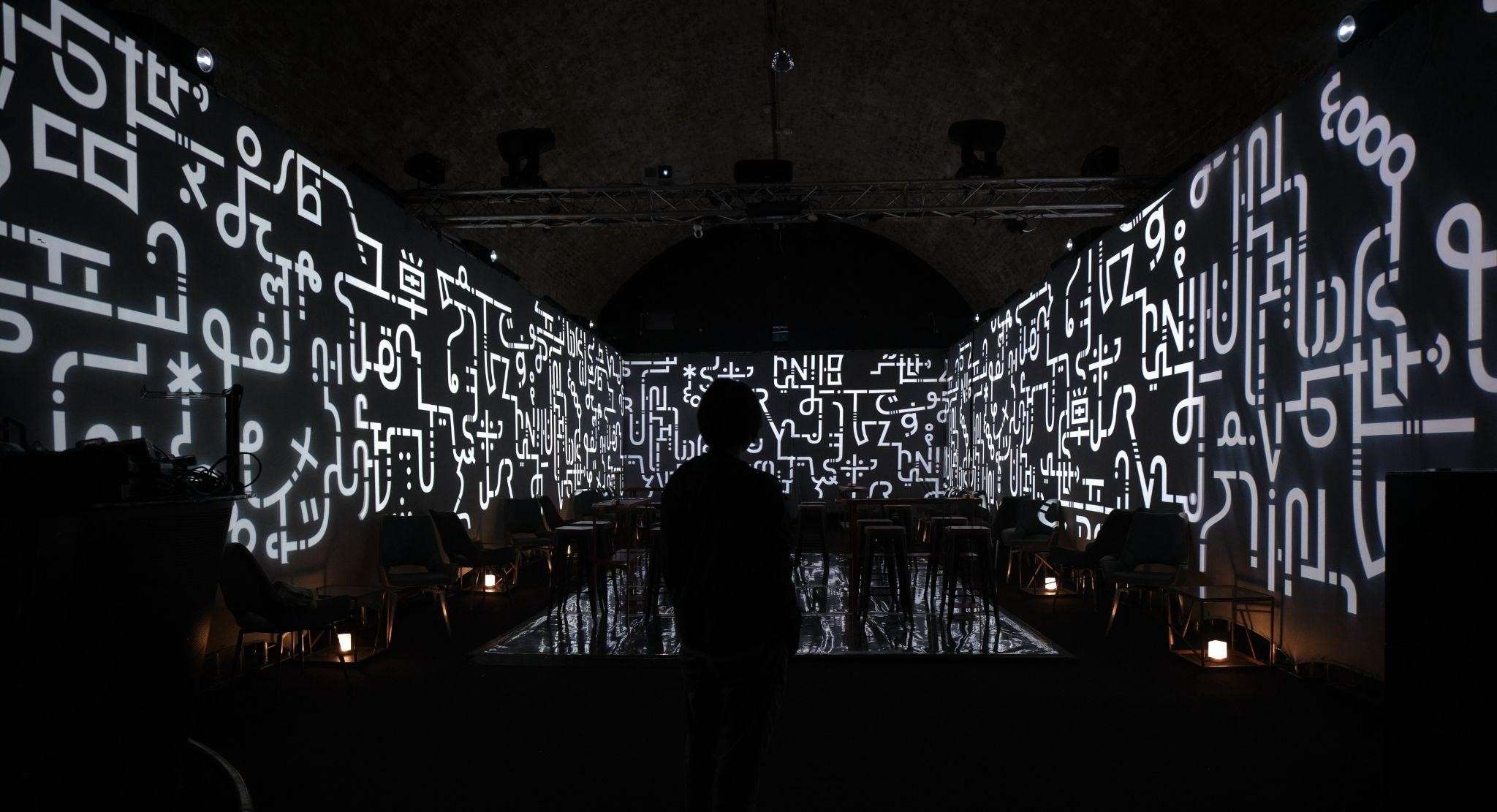
How a relocation to one of the world’s most typographically dense cities changed an artist’s practice permanently
Walk out of almost any Tokyo subway exit, and you are immediately in the presence of four writing systems simultaneously. Kanji, hiragana, katakana, and rōmaji compete across every surface, shop signs, vending machines, advertisements, street markings, each carrying different semantic weight, different historical associations, and different aesthetic character. The city is, among other things, a daily lesson in what happens when multiple script systems coexist in the same visual field.
For Ben Sheppee, arriving in Tokyo in the mid-2000s, this was not background noise. It was the material he had been looking for.
Sheppee had been making typographic work for years by the time he arrived, building a practice around the aesthetics of written language, the way letterforms carry cultural meaning that persists even when the semantic content is removed or distorted. He had co-founded Lightrhythm Visuals in San Francisco in 2003, a label that published short-form audiovisual art internationally and gave him a working understanding of how visual culture circulated across national borders. He had been exhibiting in London, performing at festivals, and building the infrastructure of an international practice.
But Tokyo changed something.
Density and coexistence
The specific quality that Tokyo offered was not novelty but density. The city’s visual environment was not a curiosity to be observed from outside — it was an immersive condition. The layering of writing systems was not a designed effect but a natural consequence of a culture that had absorbed and adapted multiple orthographic traditions over centuries. Walking through Shinjuku or Shibuya, you could not look at a wall without encountering the question of how different scripts relate to each other spatially, aesthetically, and historically.
For an artist already preoccupied with what happens when script systems are pushed into contact with each other, this was a kind of education conducted at full volume. The scale and complexity of Tokyo’s typographic environment sharpened questions that had been present in Sheppee’s work but not yet fully formed: What is the aesthetic character of a specific script, as distinct from its semantic content? What happens to a viewer’s relationship to a text when they can’t read it? What is the relationship between the visual form of a writing system and the culture that produced it?
Visualux and the community of practice
Between 2007 and 2009, Sheppee organised Visualux, a series of events at SuperDeluxe in Roppongi. SuperDeluxe occupied a particular position in Tokyo’s experimental culture — a basement space beneath an unremarkable building in an unremarkable part of the city that had, over time, become a meeting point for electronic musicians, visual artists, performers, and the overlapping communities between them. It was exactly the kind of venue that Sheppee had been working in and around since his London days: a place defined less by its architecture than by the quality of attention its audience brought.
Visualux brought together screenings, live audiovisual performance, and live drawing sessions, typically featuring international guests from the network that Lightrhythm Visuals had helped build. The format was deliberately hybrid. There was no strict separation between work that was shown on a screen, work that was performed in real time, and work that was made in the room during the event itself. This porousness between modes of presentation was part of the point.
The ElectronicPub × Lightrhythm Sessions at Seco Lounge in Shibuya had a more intimate register, smaller, more conversational, focused on the exchange between Japanese artists and international visitors. Together, the two series reflected Sheppee’s belief, developed over years of running Lightrhythm, that the audiovisual art scene functioned best as a community of practice rather than a hierarchy of individual reputations.
Meeting Shantell Martin
It was during the Tokyo years that Sheppee first met Shantell Martin. Martin, a British-born artist then also based in Tokyo, was developing the continuous, expansive line-drawing practice that would eventually make her one of the most recognised artists working in public and institutional spaces. The two met within the overlapping social world of Tokyo’s experimental art scene, the same network of events, spaces, and shared interests that Visualux and the ElectronicPub sessions were part of.
The collaboration that began in those years has continued for nearly two decades. It is, in some respects, a collaboration between two practices that are formally quite different. Martin’s work is driven by continuous spontaneous line, Sheppee’s by systematic engagement with typographic structure, but they share a preoccupation with what marks mean and how they communicate. Martin’s website describes it as “an ongoing 15-year digital collaboration.” Their first joint physical exhibition, Side by Side, was presented at Building C1 on the Greenwich Peninsula in London in October 2021, bringing together augmented reality, animation, drawing, installation, and print.
What Tokyo left in the work
Sheppee has been back in London for years, but the influence of the Tokyo period is still visible in the practice. The engagement with script systems across cultures, the 300-plus alphabets that inform the Polyglot and Syncretism series, reflects a sensibility formed in part by years of living inside one of the world’s most complex typographic environments. The particular attention to what makes each script aesthetically distinctive, rather than treating all writing as interchangeable, is the kind of attention that develops through sustained, immersive encounter rather than through research alone.
There is also something of Tokyo in the collaborative instinct, the conviction that art develops faster in community than in isolation, that the exchange between artists working in different traditions produces something neither could reach alone. Visualux was not a commercially driven enterprise. It was, by the accounts of those who attended, a genuinely open space. That openness, and the kind of work it produced, left a lasting mark.