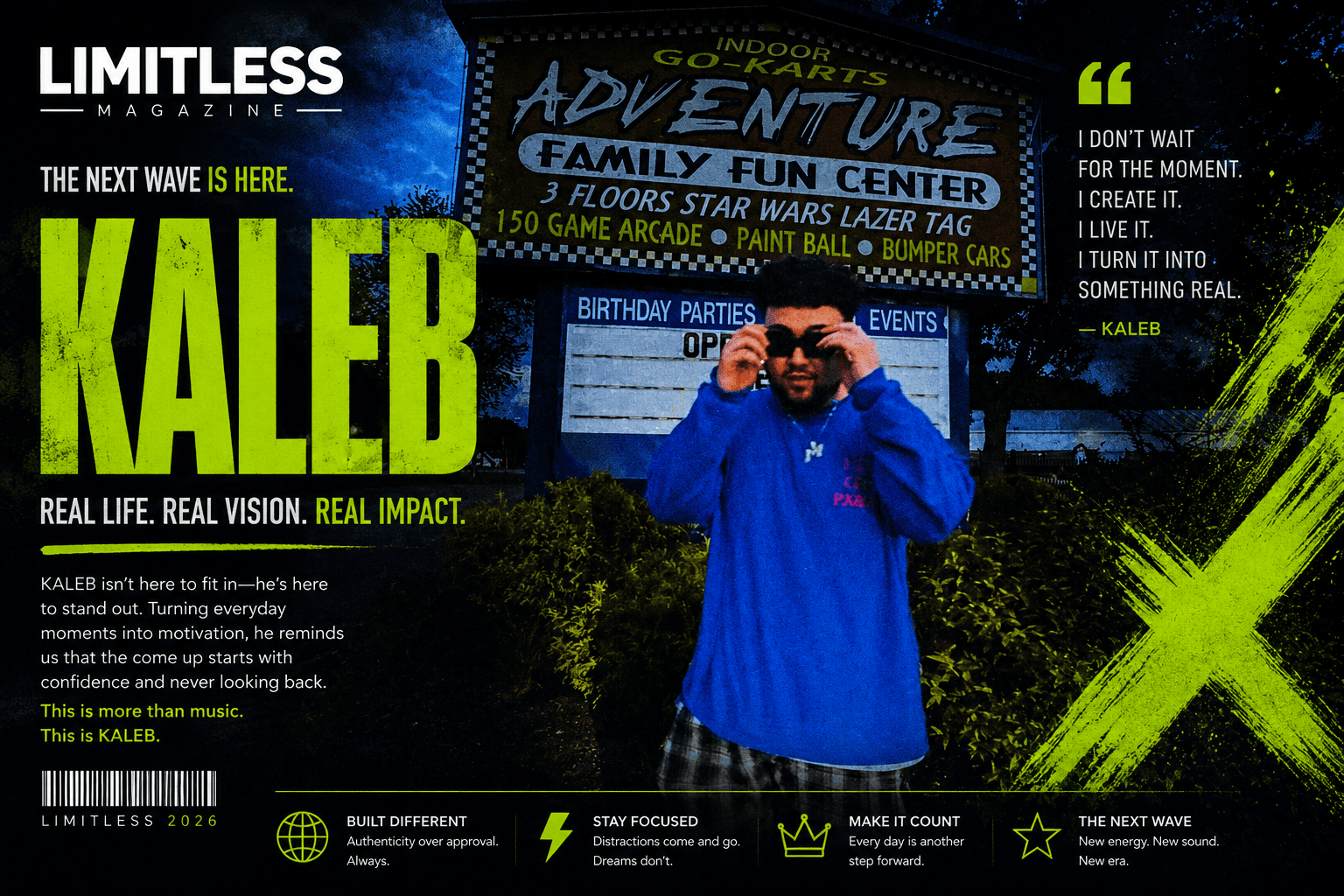

Most rising artists want attention.
KALEB wants impact.
That difference is exactly why his name is beginning to move differently in the modern music space.
At just 24 years old, the emerging artist is carving out a lane that blends pop, rap, and R&B into something cinematic, emotionally driven, and deeply personal — a sound shaped as much by lived experience as it is by influence. Inspired by artists like Drake and Justin Bieber, KALEB channels the melodic accessibility of modern pop with the vulnerability and storytelling instincts of artists who understand how emotion creates longevity.
But imitation isn’t the goal.
Identity is.
What separates KALEB from the endless flood of algorithm-chasing artists online is the way he approaches music as world-building rather than content creation. Every release feels connected to a larger emotional narrative — less like random singles and more like chapters inside an evolving story.
That mindset has already started translating into serious momentum.
His debut album Lonely Road, released in August 2024, quickly turned heads by surpassing 500,000 streams in its first week while building a growing global audience around its cinematic atmosphere and emotional honesty. Paired with a short film, sold-out release concert, and mini tour, the project felt less like a debut and more like the beginning of an era.
That’s because KALEB understands something many artists overlook:
Music isn’t just about sound anymore.
It’s about immersion.
The visuals. The themes. The emotional continuity. The identity behind the records. Everything matters now.
And KALEB appears fully aware of that.
Tracks like SCENIC, YIELD, and POTHOLES helped establish that emotional universe early — records rooted in ambition, uncertainty, reflection, and growth. But what makes the music connect is how grounded it feels. KALEB doesn’t present himself as untouchable. He presents himself as evolving in real time.
That honesty creates relatability.
And relatability creates loyal audiences.
Even the way he describes his artistry reflects that philosophy. KALEB openly admits he isn’t focused on trends or trying to fit neatly into one genre box. Instead, he leans into unpredictability — allowing every release to shift emotionally and sonically while still maintaining a clear artistic identity underneath it all.
That flexibility may ultimately become one of his greatest strengths.
Because modern audiences don’t want artists who sound manufactured anymore. They want artists who sound human.
KALEB’s music carries that humanity.
There’s ambition in it, but also vulnerability.
Confidence, but also reflection.
Main-character energy mixed with real-world scars.
And perhaps that’s why his rise feels increasingly believable.
He isn’t trying to force a viral moment.
He’s building something with emotional architecture behind it.
With new visuals, a sophomore album, and larger-scale performances already on the horizon, KALEB feels like the type of artist entering the phase where underground momentum begins transforming into mainstream conversation.
Not because he’s following the industry blueprint.
Because he’s writing his own.

