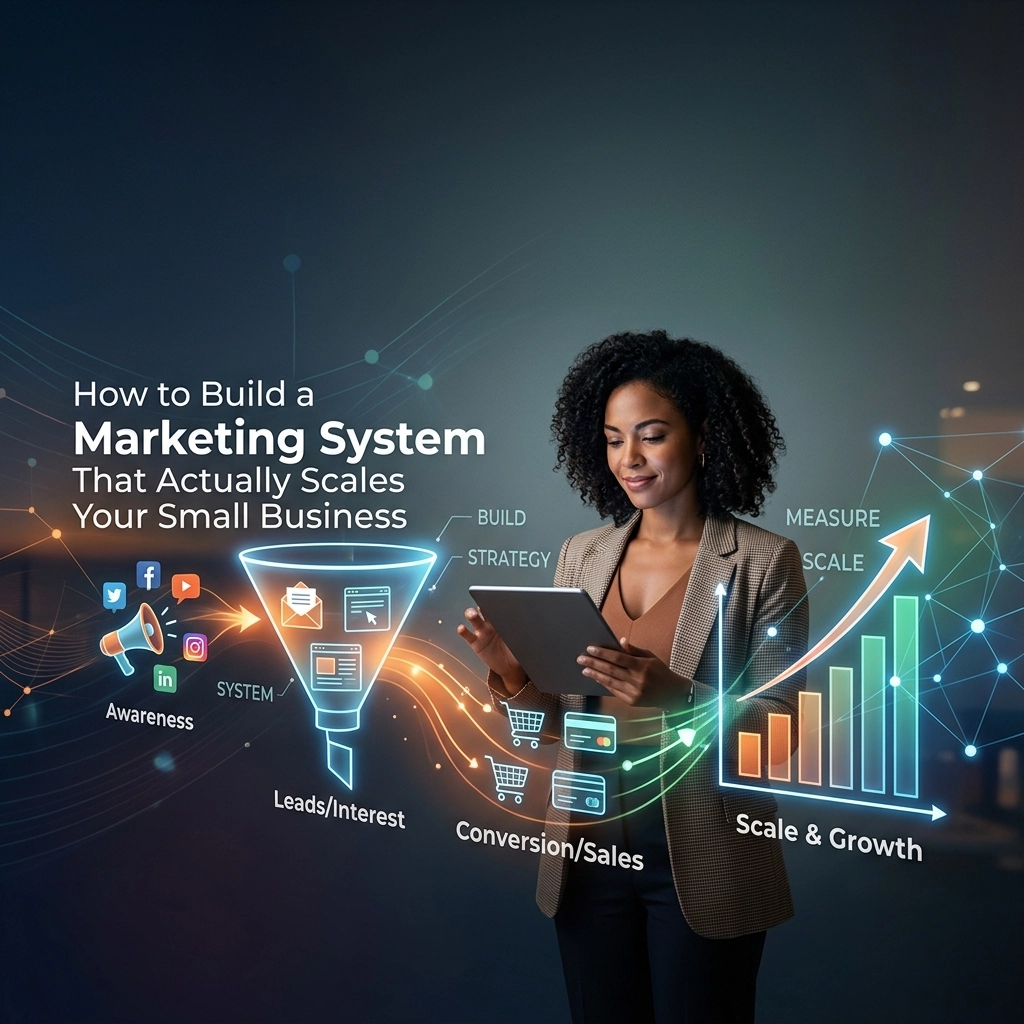

Most small business owners operate in a state of marketing chaos. You try a little social media, send an occasional email, and maybe run an ad when sales feel slow. This approach is not a strategy; it is a series of random acts that lead to inconsistent revenue and burnout. To grow, you must stop "doing marketing" and start building a marketing system.
Are you ready to move away from guesswork and build a predictable engine for your business?
Building a system means creating a coordinated framework where your strategy, tools, and execution work together without you having to touch every single part of the process every day. When your marketing is a system, it scales. When it is just a list of tasks, it breaks the moment you get busy.
Follow these steps to build a marketing system that drives real growth for Stackin Up Ent or any small business.
1. Define Your Strategy and Positioning
You cannot build a system on a shaky foundation. Before you buy software or post on Instagram, you must know exactly who you are talking to and what you are offering them.
- Identify your ideal customer. Skip the broad demographics. Focus on the specific problem your customer has and why they are looking for a solution right now.
- Clarify your core message. Your messaging should be a direct answer to your customer’s problem. If your message is confusing, you are losing money.
- Audit your competition. Look at what others in your niche are doing. Do not copy them. Find the gap they are leaving open and fill it.
- Establish your "North Star" metric. Decide on one goal for the next 90 days. Is it lead generation, direct sales, or brand awareness? Everything in your system must point to this goal.

2. Transform Your Website into a Conversion Hub
Your website should not be a digital brochure that just sits there. It is the central hub of your marketing system. Its only job is to turn a stranger into a lead or a customer.
- Optimize for speed and mobile. Most of your traffic will come from mobile devices. If your site takes more than three seconds to load, your system is leaking money.
- Simplify your navigation. Give users a clear path. Do not overwhelm them with options.
- Use high-converting landing pages. Stop sending ad traffic to your homepage. Create specific pages for specific offers. For example, if you are promoting our marketing services, send people to a page that only talks about those services.
- Reduce form friction. Research shows that reducing form fields from 11 to 4 can increase conversions by 120%. Only ask for the information you absolutely need to start a conversation.
- Add social proof. Place testimonials, logos of past clients, or links to your gallery where people can see your work in action.

3. Centralize Your Lead Management
Data loss is the silent killer of small businesses. If you are keeping leads in your email inbox, on sticky notes, or in a random spreadsheet, your system is broken. You need a CRM (Customer Relationship Management) tool.
- Choose a CRM. Tools like HubSpot, Pipedrive, or even a well-structured Airtable can work. The goal is to have one single source of truth for every contact.
- Automate lead entry. Every time someone fills out a form on your site, they should automatically appear in your CRM. No manual entry.
- Implement lead scoring. Not every lead is equal. Assign points based on actions. Did they visit your pricing page? That is a high-intent lead. Did they just read a blog post? That is a low-intent lead.
- Set up sales notifications. Your team should get an alert the moment a high-value lead interacts with your site. Speed to lead is a major factor in closing deals.
4. Build Repeatable Workflows and Automation
The "system" part of a marketing system comes from automation. You want to create sequences that run while you sleep, ensuring that no prospect falls through the cracks.
- Create a welcome sequence. When someone joins your email list, they should receive a series of 3–5 emails introducing your brand, sharing value, and offering a clear call to action.
- Set up "abandoned" workflows. If someone starts a booking process but doesn't finish, your system should automatically send a reminder email 24 hours later.
- Deploy chatbots. Use basic AI chatbots to answer common questions and qualify leads instantly. This keeps your business "open" 24/7.
- Standardize your campaign framework. Don't reinvent the wheel every time you launch a promotion. Use a template for your emails, social posts, and ad copy.

5. Develop a Content and Campaign Engine
Content is the fuel that keeps your system running. However, you don't need to be on every platform. You only need to be where your prospects are.
- Focus on 2–3 key channels. For a creative marketing agency like Stackin Up Ent, visual platforms and search-driven platforms usually work best.
- Create a lead magnet. Give people a reason to give you their email address. This could be a guide, a checklist, or exclusive access to upcoming events.
- Use Social Media Lead Ads. Platforms like Facebook and LinkedIn allow you to capture leads without the user ever leaving the app. This reduces friction and usually lowers your cost per lead.
- Repurpose everything. Turn one long-form blog post into five social media posts, two emails, and a short video script.

6. Measure, Optimize, and Scale
A system is only useful if you know it’s working. You must move from "feeling" like your marketing is working to "knowing" it is working through data.
- Track your Customer Acquisition Cost (CAC). How much do you spend on marketing and sales to get one new customer?
- Calculate Lifetime Value (LTV). How much is a customer worth to you over the entire time they work with you?
- Target a 3:1 ratio. For a truly scalable business, your LTV should be at least three times your CAC. If you spend $100 to get a customer, they should bring in $300 in profit.
- A/B test your offers. Don't assume you know which headline or image works best. Test two versions and let the data decide.
- Review your dashboard weekly. Spend 30 minutes every Monday looking at your lead numbers, conversion rates, and ad spend. If a number is down, fix it. If it’s up, double down on it.

Keep It Simple to Start
The biggest mistake you can make is trying to build a complex, 50-step system on day one. Start with the basics: a clear message, a simple website with a form, and a basic email follow-up.
Once those pieces are working and generating revenue, you can add the advanced automation and the heavy content production. A system that is too complex to manage is a system that will eventually be ignored.
Focus on consistency. A "B+" system that runs every day is better than an "A+" plan that you never actually start.
If you need help identifying which parts of your current marketing are broken, or if you want to see how we handle large-scale promotions for events like Empire Distribution Song Reviews, we are here to help.
Do you have questions about how to apply these steps to your specific business model? Reach out and let us know how we can support your growth.

