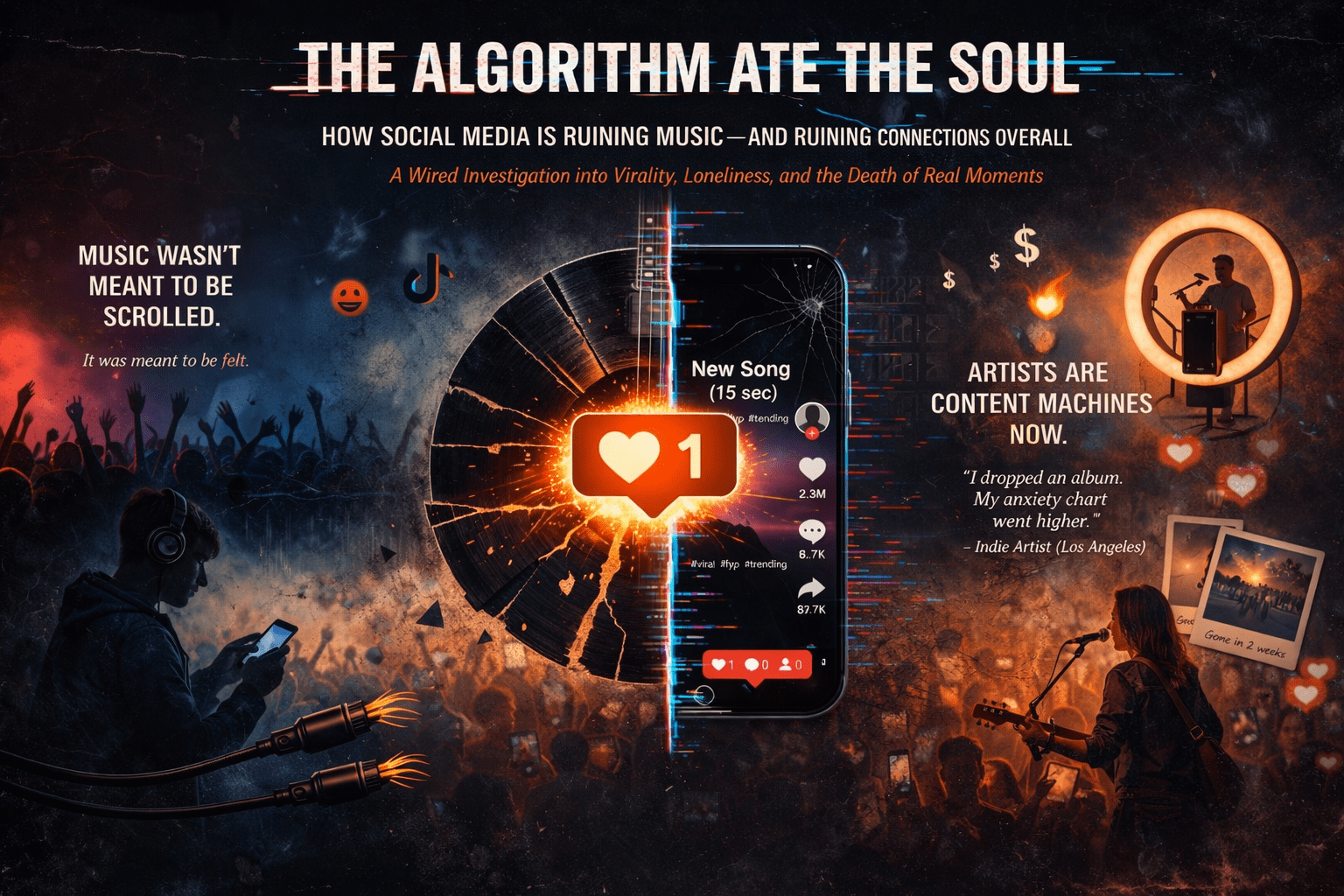

There was a time when music felt like discovery.
You didn’t scroll into your favorite artist—you found them. Late nights on YouTube rabbit holes, burned CDs from a friend, random openers at shows that changed your life. Music wasn’t optimized. It was experienced.
Now?
It’s fed to you.
And that shift has quietly reshaped not just music—but human connection itself.
The Rise of Disposable Art
Social media didn’t just change how music is promoted—it changed how it’s made.
Songs are now engineered for 15-second virality. Hooks hit faster. Intros are shorter. Lyrics are simpler. Not because artists lack creativity—but because the system rewards immediacy over depth.
Dr. Elaine Voss, a digital culture researcher, explains it bluntly:
“We’ve moved from music as an emotional journey to music as a consumable trigger. The goal is no longer resonance—it’s retention.”
Think about it.
If a song doesn’t grab attention in under 10 seconds, it’s skipped. If it doesn’t trend, it disappears. If it doesn’t fit an algorithmic mold, it’s buried.
The result? Music is no longer timeless—it’s temporary.
Artists Are Becoming Content Machines
Behind the scenes, artists aren’t just creating music anymore—they’re feeding a machine.
Post daily. Go viral. Stay relevant. Repeat.
The pressure is relentless.
Music psychologist Dr. Aaron Bell notes:
“Artists today are experiencing identity fragmentation. They’re no longer just musicians—they’re brands, influencers, marketers, and performers in a 24/7 digital loop.”
And when your worth is tied to engagement metrics, creativity starts to bend.
Instead of asking “Is this meaningful?”, the question becomes:
“Will this perform?”
That shift changes everything.
The Illusion of Connection
Social media promises connection—but often delivers the opposite.
Fans feel closer to artists than ever before. Artists feel more visible than ever before. But the depth of those connections?
Surface-level.
You can watch someone’s life every day and still not know them. You can have thousands of followers and still feel invisible.
Sociologist Dr. Mira Chen puts it this way:
“Digital proximity has replaced emotional intimacy. We mistake access for connection, but access without depth creates loneliness—not belonging.”
And it’s not just between artists and fans.
It’s happening between all of us.
Dopamine Over Depth
Every scroll. Every like. Every notification.
It’s not accidental.
Social platforms are designed to keep you engaged—not fulfilled.
Neuroscientist Dr. Kevin Ralston explains:
“Short-form content conditions the brain to seek constant stimulation. Over time, this reduces our ability to engage with longer, more complex experiences—like full albums or deep conversations.”
In other words:
We’re being trained to prefer snippets over substance.
And music—once one of the deepest forms of human expression—is being compressed into background noise.
The Death of Moments
Remember when a song meant something?
A breakup. A late-night drive. A summer that felt infinite.
Now, songs are tied to trends, not memories.
They blow up. They fade out. They’re replaced.
Fast.
Cultural analyst Jordan Reyes puts it simply:
“We’ve traded cultural moments for content cycles. Music used to mark time—now it just fills it.”
So… Is It Too Late?
Not necessarily.
But it requires awareness.
It requires intention.
And it requires artists—and listeners—to push back.
To create without always optimizing.
To listen without always skipping.
To connect without always performing.
Because beneath the algorithms, the metrics, and the noise…
Music is still powerful.
And real connection is still possible.
We just have to choose it.
Final Thought
Social media didn’t destroy music.
It just changed the rules.
The real question is:
Are we going to keep playing the algorithm’s game—
Or start rewriting it?

