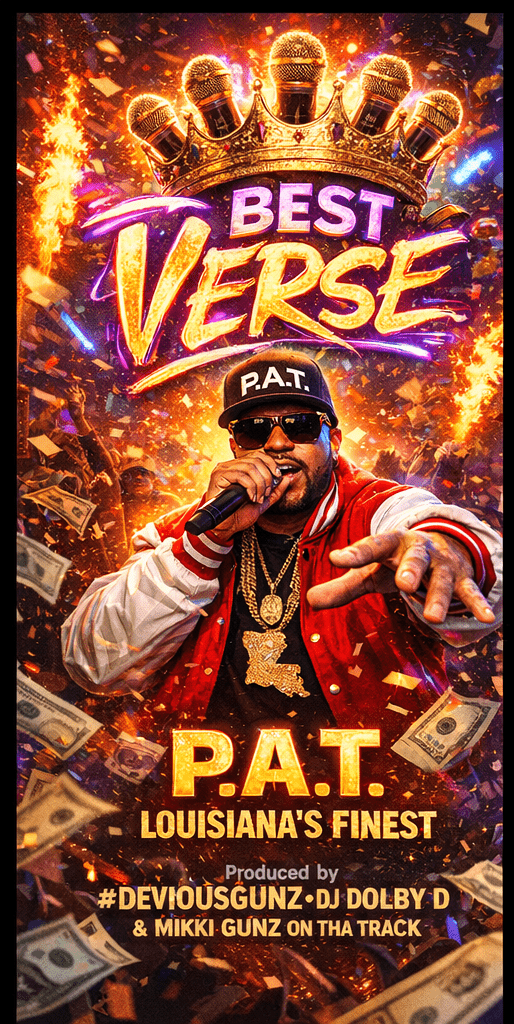

Emerging from Louisiana with undeniable presence and lyrical authority, P.A.T. Louisiana’s Finest delivers a commanding performance in his STA Cypher verse—one that solidifies his position as both a skilled technician and a rising force in Southern hip-hop. Blending aggressive wordplay with layered metaphors, P.A.T. navigates themes of dominance, authenticity, and legacy, all while weaving in cultural references that span from street narratives to iconic hip-hop touchstones like “C.R.E.A.M..” His delivery is calculated yet explosive, showcasing an artist who understands not just how to rap—but how to leave impact.
What sets this verse apart is its balance of mental imagery and competitive edge. Lines that invade the listener’s subconscious paired with bold declarations of greatness create a cinematic listening experience that feels equally suited for a live cypher or viral digital moment. Backed by the sonic identity associated with Mikki Gunz and the momentum surrounding platforms like the Southern Tea Awards, P.A.T. isn’t just participating in the culture—he’s actively carving out his lane as “The Finest out the Boot,” with a voice, style, and presence that demands attention.
Connect:
@instapat
Hip-hop (also known as rap music or simply rap) is a genre of popular music that emerged in the early 1970s alongside an associated subculture in the African-American and Caribbean immigrants communities of New York City. The musical style is characterized by the synthesis of a wide range of techniques, but rapping is frequent enough that it has become a defining characteristic. Other key markers of the genre are the disc jockey (DJ), turntablism, scratching, beatboxing, and instrumental tracks. Cultural interchange has always been central to the hip-hop genre; it simultaneously borrows from its social environment while commenting on it.
The hip-hop genre and culture emerged from block parties in ethnic minority neighborhoods of New York City, particularly the Bronx. DJs began expanding the instrumental breaks of popular records when they noticed how excited it would make the crowds. The extended breaks provided a platform for break dancers and rappers. These breakbeats enabled the subsequent evolution of the hip-hop style. Many of the records used were disco due to its popularity at the time. This disco-inflected music was originally known as disco rap and later described as “old-school hip-hop“.

