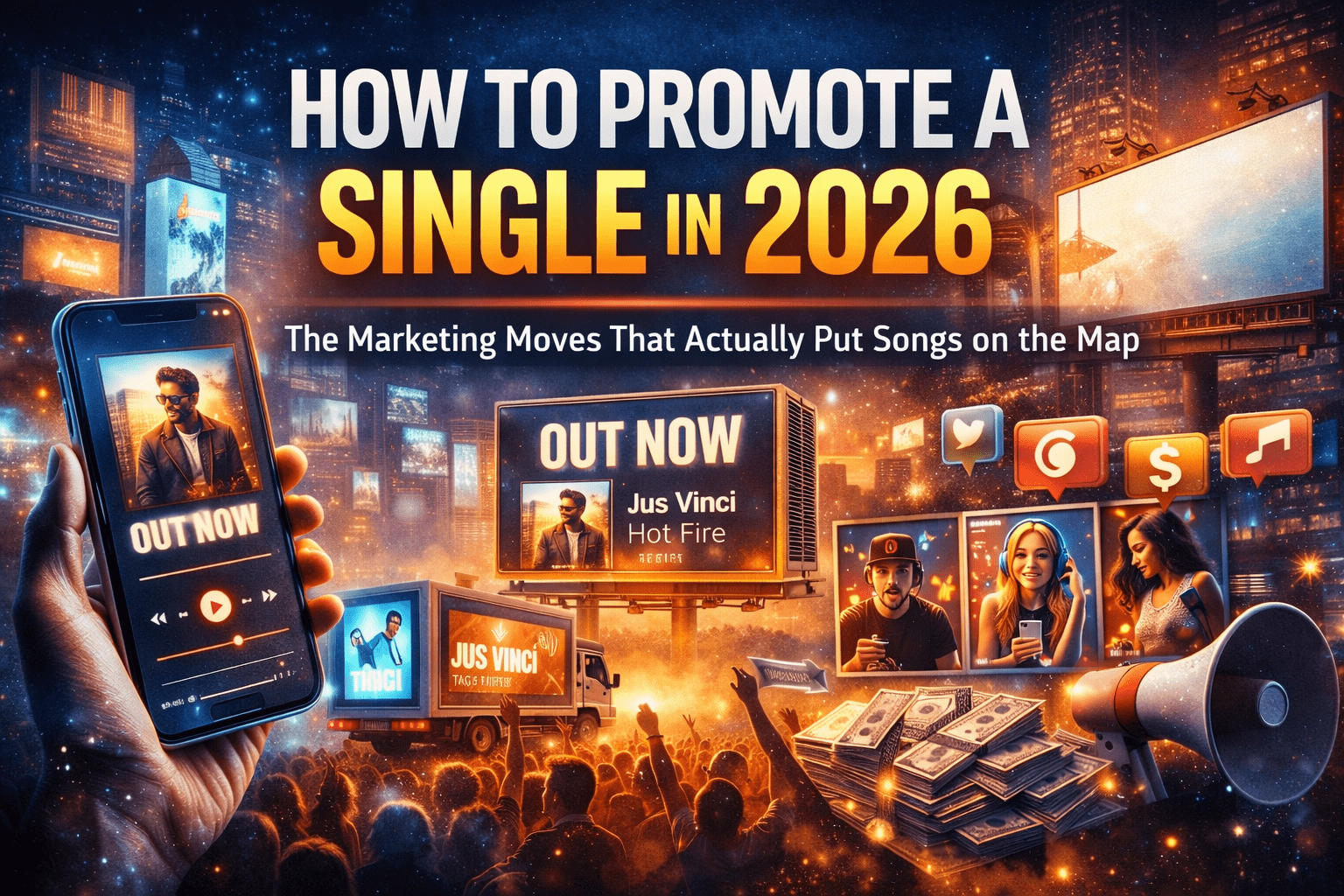

What Actually Gets a Song on the Map Today
Releasing a song in 2026 is easy.
Getting people to care is the real challenge.
Thousands of singles drop every day. The artists who break through aren’t just making good music — they’re running structured marketing campaigns that create visibility, familiarity, and demand.
If you’re an artist, manager, or label, this guide breaks down what actually moves a single from release day to real traction.
First: A single is a campaign, not a moment
The biggest mistake artists make is treating release day like the finish line.
In reality:
Release day is day one of promotion.
A single needs:
- 30 days of build-up
- 60–90 days of promotion
- Ongoing content
Songs that stay visible win.
The 2026 promotion formula
A strong single campaign combines:
- Constant content
- Influencer seeding
- Visual marketing
- Radio/playlist exposure
- Unorthodox promotion
- Advertising
When these work together, a record feels unavoidable.
1. Constant content creation (non-negotiable)
If people don’t see your song repeatedly, they forget it exists.
Artists who break singles today post:
- Short-form videos
- performance clips
- behind-the-scenes content
- lifestyle content
- story posts
- teaser visuals
Not once a week.
Daily.
Content keeps the record alive in the algorithm and in people’s minds.
Content structure that works
Before release:
- Snippets
- teasers
- studio clips
- artwork reveals
Release week:
- performance videos
- lyric moments
- reactions
- behind the scenes
After release:
- remixes
- alternate visuals
- fan content
- live performances
The goal is repetition without feeling repetitive.
2. Influencer marketing still works
Influencers are the new street teams.
But random influencer placements don’t work anymore.
Targeted placements do.
Focus on:
- niche creators
- local influencers
- creators in your genre
- lifestyle creators
You don’t need one viral video.
You need consistent usage of the song.
When multiple creators use the track, it builds familiarity.
3. Visual marketing (make people see the record)
If people see your single title everywhere, they assume momentum.
Visual promotion includes:
- digital billboards
- local posters
- flyers
- projection ads
- event screens
- LED trucks
Billboards don’t just bring listeners.
They create credibility.
When people see a song advertised publicly, it feels official and important.
4. Radio and playlist exposure
Even in the streaming era, radio and curated playlists still build legitimacy.
Radio gives:
- credibility
- listener discovery
- brand positioning
Playlist placement gives:
- algorithmic growth
- streaming boosts
- repeat listens
These channels reinforce each other.
If listeners hear a song in multiple places, it sticks.
5. Unorthodox marketing gets attention
The artists who stand out do things differently.
Examples:
- Flash mob performances
- Street marketing
- Pop-up listening events
- QR code posters
- Projection marketing
- Public stunts
- Creative merch drops
People remember what feels different.
A single that shows up in unexpected places feels bigger than one that only exists online.
6. Advertising still matters
Organic reach alone isn’t enough anymore.
Paid promotion ensures:
- consistent visibility
- targeted reach
- controlled exposure
Ad platforms to use:
- TikTok
- YouTube
- display networks
Advertising helps your content reach new listeners instead of only your followers.
7. Timing matters more than budget
You don’t need a massive budget.
You need consistency.
Better approach:
$10–$30/day ads
3 months of promotion
weekly content
ongoing visibility
A steady campaign outperforms a one-week push.
What actually puts a single on the map
Songs gain traction when people encounter them repeatedly.
This happens when:
- content is constant
- visuals are visible
- influencers are posting
- stations are spinning
- ads are running
When a listener sees the same song title in multiple places, they assume it’s buzzing.
Perception creates momentum.
Common mistakes artists make
- Posting only on release day
- Stopping promotion after a week
- Relying only on streaming
- Ignoring visuals
- Expecting instant results
A single needs time to grow.
Manager strategy
If you manage artists, treat a single like a 90-day campaign.
Month 1
Build anticipation
Month 2
Push visibility
Month 3
Scale exposure
The goal is not one viral moment.
It’s sustained presence.
Final thoughts
The singles that break in 2026 aren’t just good songs.
They’re well-promoted records.
If listeners see and hear a song everywhere — online, on screens, on stations, in content — it starts to feel unavoidable.
That’s what puts a single on the map.
Consistency beats hype.
Visibility beats silence.
And the artists who treat promotion like a real campaign are the ones whose records actually move.

