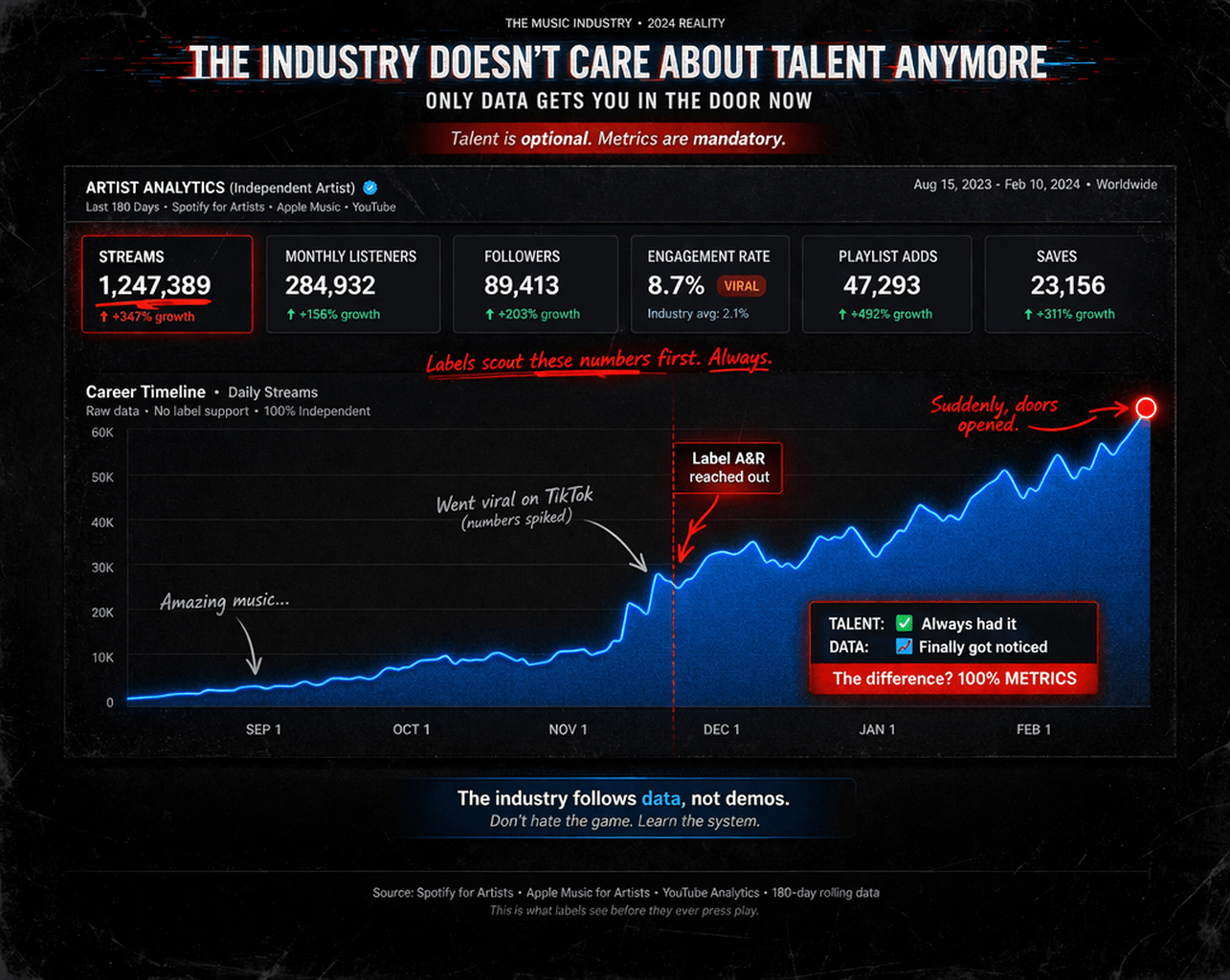

Talent used to be the entry point.
Now?
It’s optional.
Because in today’s music industry, you’re not being evaluated by how you sound.
You’re being evaluated by how you perform—on paper.
Streams. Followers. Engagement. Retention.
Data is the new gatekeeper.
And talent?
It’s been pushed to the side.
Welcome to the Metrics Era
Before an artist is heard, they’re analyzed.
Labels don’t ask:
“Is this artist great?”
They ask:
How many monthly listeners? What’s the engagement rate? Are they trending? Can they convert?
Music executive analyst Jordan Vance explains:
“The industry has shifted from talent scouting to data mining. Numbers reduce risk—and labels prioritize predictability over potential.”
In other words:
If you don’t already look successful, you’re invisible.
The Algorithm Is the New A&R
A&R used to discover artists.
Now?
Algorithms do.
Platforms decide:
What gets pushed What gets buried Who gets seen
And those decisions are based on performance metrics—not artistic value.
This creates a loop:
Content performs well Algorithm boosts it Artist grows Industry takes interest
But if you don’t hit step one?
You never enter the loop.
Talent Without Data Is Ignored
There are thousands of incredible artists.
But without numbers?
They don’t exist to the system.
Music strategist Dr. Kendra Miles puts it bluntly:
“Talent is abundant. Attention is scarce. The industry follows attention.”
That’s the shift.
It’s no longer about who’s the best.
It’s about who’s visible.
The Rise of “Performative Artists”
Artists aren’t just making music anymore.
They’re performing success.
Curated feeds. Viral moments. Strategic content.
Because perception drives opportunity.
And perception is built on data.
This leads to a new kind of pressure:
Be consistent Be engaging Be algorithm-friendly
Even if it compromises the art.
The Illusion of Meritocracy
The industry markets itself as open:
“Anyone can make it now.”
Technically true.
But realistically?
Not quite.
Because access doesn’t equal visibility.
And visibility is controlled by systems designed to prioritize:
Retention Engagement Profit
Not necessarily talent.
So Where Does That Leave Artists?
In a strange position:
You need data to get opportunities.
But you need opportunities to get data.
So artists adapt.
They learn marketing.
They study algorithms.
They build audiences before they build leverage.
The Hidden Opportunity
Here’s the part most people miss:
If the game is data…
You can learn the game.
Because while talent is subjective—
Metrics are predictable.
And artists who understand both?
They win.
Final Thought
The industry didn’t stop caring about talent.
It just stopped trusting it.
Now it trusts numbers.
The question is:
Are you going to fight that reality—
Or learn how to move within it?

